
To what extent can a thread be considered a fine thread? Let's define it this way: a coarse thread can be defined as a standard thread; while a fine thread, relative to a coarse thread, has a different number of teeth per inch (i.e., a different pitch) for the same nominal diameter. Coarse threads have a larger pitch, while fine threads have a smaller pitch. In other words, for the 1/2-13 and 1/2-20 specifications, the former is coarse and the latter is fine. Therefore, they are represented as 1/2-13UNC and 1/2-20UNF.
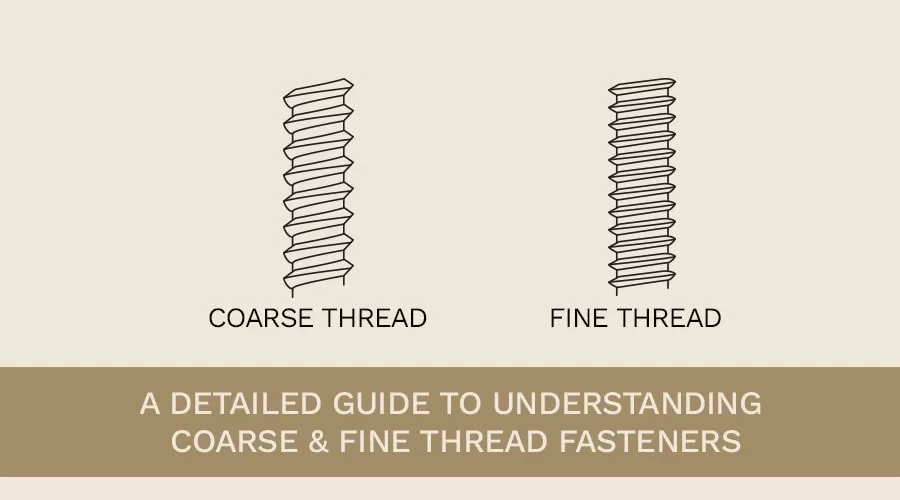
Since there are two different thread specifications for the same nominal diameter, how do we choose between coarse and fine threads?

Coarse thread

Coarse threads are essentially standard threads. Unless otherwise specified, most stainless steel screws and other fasteners we buy are coarse threads.

Coarse threads are characterized by higher strength, good interchangeability, and readily available standards for reference. Generally, coarse threads should be the optimal choice.

Compared to fine threads, due to their larger pitch and helix angle, their self-locking ability is poorer. In vibration environments, anti-loosening washers and self-locking devices need to be added. Their advantages include easy assembly and disassembly, a complete range of compatible standard parts, and easy interchangeability.

Coarse threads do not require pitch specification when marked, such as M8, M12-6H, M16-7H, etc., and are mainly used for connection threads.
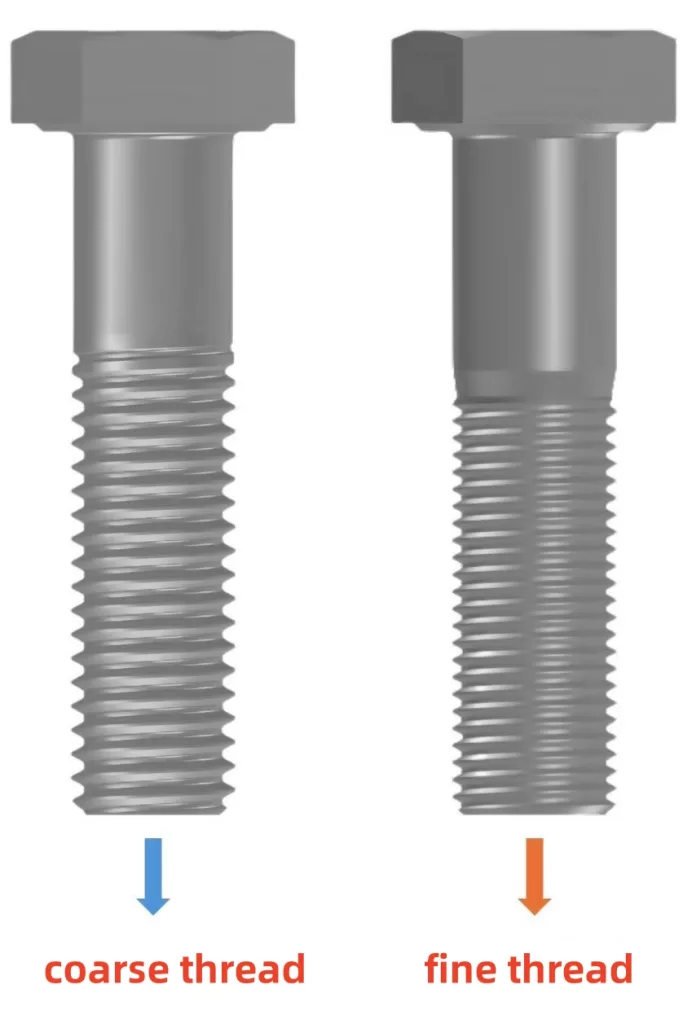
Fine thread

Fine threads, the opposite of coarse threads, are designed to meet special application requirements that coarse threads cannot satisfy. Fine threads also come in pitch series, with smaller pitches, making them more self-locking and anti-loosening. They also have more threads, reducing leakage and achieving a sealing effect. In precision applications, fine-pitch stainless steel screws offer easier and more accurate control and adjustment.
The disadvantages are that the tensile strength and overall strength are lower than those of coarse-threaded screws, and the threads are easily damaged. It is not recommended to disassemble and assemble them repeatedly. The matching nuts and other fasteners must be equally precise. Even slight errors in size can easily cause both the screws and nuts to be damaged.
Fine-pitch threads are mainly used in metric pipe fittings of hydraulic systems, mechanical transmission components, thin-walled parts with insufficient strength, internal machine parts with space constraints, and shafts with high self-locking requirements. When marking fine-pitch threads, the pitch must be specified to distinguish them from coarse-pitch threads.
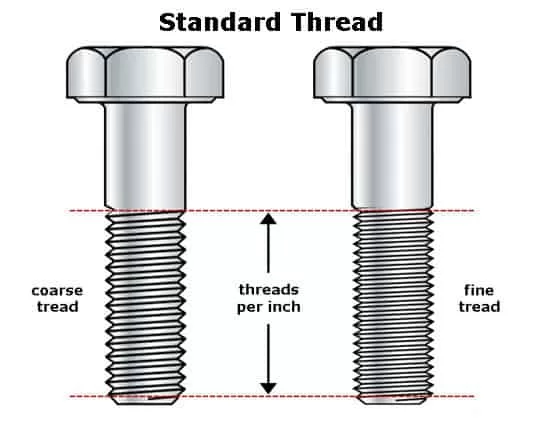
How to choose between coarse and fine threads?
Both coarse and fine thread screws are used for fastening.

Fine thread screws are generally used to fasten thin-walled parts and parts with high vibration damping requirements. Fine threads have better self-locking properties, thus offering stronger resistance to vibration and loosening. However, due to their shallower thread depth, they are less able to withstand greater tensile forces than coarse threads.

Without anti-loosening measures, fine threads offer slightly better anti-loosening performance than coarse threads and are generally used for thin-walled parts and parts with high vibration damping requirements.

Fine threads are more advantageous for adjustment purposes. Disadvantages of fine threads: They are not suitable for use on materials with excessively coarse microstructure and low strength; they are also prone to stripping when tightened with excessive force.
1. Applications of Coarse Threads

Coarse thread series (M/UNC/UNRC) are generally used in the mass production of threaded fasteners, such as bolts, screws, and nuts. They have unique advantages in applications requiring rapid assembly or disassembly and in certain rough operations prone to corrosion and damage. However, their self-locking properties are not as good as fine and ultra-fine threads.
2. Applications of Fine Threads

Fine thread series (MF/UNF/UNRF) are typically used in applications requiring high fastener strength. Because fine threads have shallower teeth and a larger minor diameter than coarse threads, they offer higher thread strength compared to coarse threads of the same nominal size. Furthermore, fine threads can be used for fine-tuning applications.